

 Embeddings
  Apache 2.0 License
 jina-embedding-b-en-v1
Apache-2.0 Hugging Face
.%20Filled%20%23ffffff%20like%20the%20other%20csp%20marks%20so%20.svg-img%20inverts%20it%20for%20the%20light%20theme.%20--%3e%3cpath%20fill='%23ffffff'%20d='M13.983%2011.078h2.119a.186.186%200%2000.186-.185V9.006a.186.186%200%2000-.186-.186h-2.119a.185.185%200%2000-.185.185v1.888c0%20.102.083.185.185.185m-2.954-5.43h2.118a.186.186%200%2000.186-.186V3.574a.186.186%200%2000-.186-.185h-2.118a.185.185%200%2000-.185.185v1.888c0%20.102.082.185.185.185m0%202.716h2.118a.187.187%200%2000.186-.186V6.29a.186.186%200%2000-.186-.185h-2.118a.185.185%200%2000-.185.185v1.887c0%20.102.082.185.185.186m-2.93%200h2.12a.186.186%200%2000.184-.186V6.29a.185.185%200%2000-.185-.185H8.1a.185.185%200%2000-.185.185v1.887c0%20.102.083.185.185.186m-2.964%200h2.119a.186.186%200%2000.185-.186V6.29a.185.185%200%2000-.185-.185H5.136a.186.186%200%2000-.186.185v1.887c0%20.102.084.185.186.186m5.893%202.715h2.118a.186.186%200%2000.186-.185V9.006a.186.186%200%2000-.186-.186h-2.118a.185.185%200%2000-.185.185v1.888c0%20.102.082.185.185.185m-2.93%200h2.12a.185.185%200%2000.184-.185V9.006a.185.185%200%2000-.184-.186h-2.12a.185.185%200%2000-.184.185v1.888c0%20.102.083.185.185.185m-2.964%200h2.119a.185.185%200%2000.185-.185V9.006a.185.185%200%2000-.184-.186h-2.12a.186.186%200%2000-.186.186v1.887c0%20.102.084.185.186.185m-2.92%200h2.12a.185.185%200%2000.184-.185V9.006a.185.185%200%2000-.184-.186h-2.12a.185.185%200%2000-.184.185v1.888c0%20.102.082.185.185.185M23.763%209.89c-.065-.051-.672-.51-1.954-.51-.338.001-.676.03-1.01.087-.248-1.7-1.653-2.53-1.716-2.566l-.344-.199-.226.327c-.284.438-.49.922-.612%201.43-.23.97-.09%201.882.403%202.661-.595.332-1.55.413-1.744.42H.751a.751.751%200%2000-.75.748%2011.376%2011.376%200%2000.692%204.062c.545%201.428%201.355%202.48%202.41%203.124%201.18.723%203.1%201.137%205.275%201.137.983.003%201.963-.086%202.93-.266a12.248%2012.248%200%20003.823-1.389c.98-.567%201.86-1.288%202.61-2.136%201.252-1.418%201.998-2.997%202.553-4.4h.221c1.372%200%202.215-.549%202.68-1.009.309-.293.55-.65.707-1.046l.098-.288Z'/%3e%3c/svg%3e) Air-gapped
Air-gapped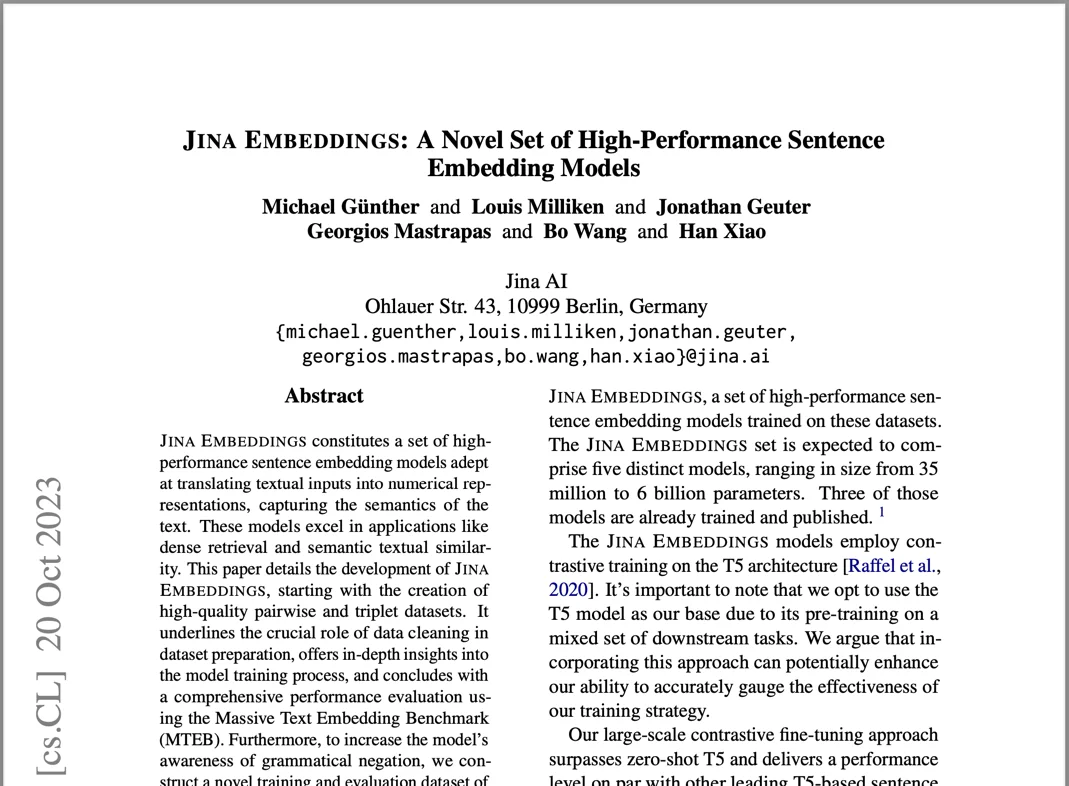
Overview
jina-embedding-b-en-v1 was Jina AI's first publicly released text embedding model: a 110M-parameter bidirectional encoder that maps English text into 768-dimensional vectors. Designed for semantic search, similarity comparison, and content recommendation at a time when 512-token context was the industry standard, it established Jina's entry into the open-source embedding space. The model is now legacy and has been superseded by the v2 and v3 families, which support 8K+ token contexts and multilingual input.
Methods
The model uses a T5-encoder architecture with mean pooling to produce fixed-length 768-dimensional representations. Training followed a two-phase contrastive recipe on the Linnaeus-Clean dataset (385M sentence pairs filtered from 1.6B candidates): first, InfoNCE loss on positive text pairs to learn semantic alignment; second, triplet loss to sharpen discrimination between similar but semantically distinct texts. A key design decision was the mean-pooling strategy, which averages token-level representations to produce a single vector capturing global sentence meaning. The 512-token context window was standard for its era but limits the model's usefulness for long-document applications.
Performance
On STS12, the model achieved a correlation score of 0.751, outperforming all-mpnet-base-v2 and all-minilm-l6-v2 at release. It demonstrated strong performance across standard English sentence-embedding tasks while maintaining fast inference times suitable for production. Its 512-token context window and English-only focus made it unsuitable for the long-document and multilingual workloads that became standard by 2025. The model has been superseded by jina-embeddings-v2-base-en (8K context, bidirectional ALiBi) and jina-embeddings-v3 (570M params, 89 languages, task-specific LoRA adapters).
Best Practice
This model is legacy and should not be used for new projects. If migrating from jina-embedding-b-en-v1, upgrade to jina-embeddings-v5-text-small for current workloads — it supports 32K token context, 89 languages, and task-specific LoRA adapters. For code-specific embedding needs, use jina-code-embeddings-1.5b. The model requires CUDA-capable hardware for optimal performance and accepts inputs up to 512 tokens. It is not suitable for multilingual content, long documents, or code-centric applications.