

 Embeddings
  Qwen Research License
 jina-embeddings-v4
Qwen Research License GGUF
GGUF Jina API
 Hugging Face
 Air-gapped
Overview
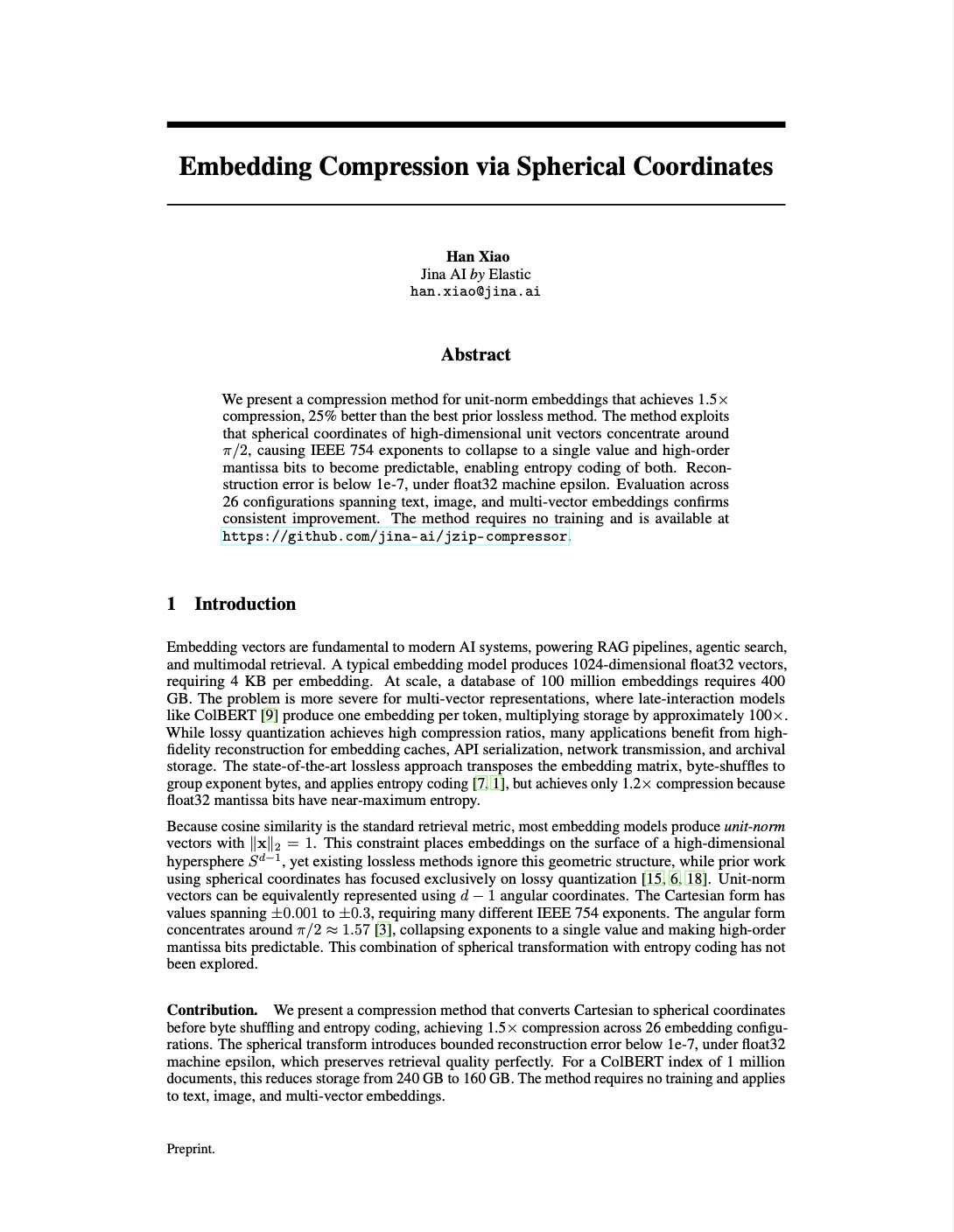
jina-embeddings-v4 is a 3.8B-parameter multimodal embedding model that unifies text and image representations in a single architecture. It uniquely supports both single-vector (dense) and multi-vector (late-interaction/ColBERT-style) output modes, allowing teams to trade off indexing efficiency against retrieval precision without switching models. The model achieves state-of-the-art performance on visually rich document retrieval, processing tables, charts, diagrams, and mixed-media formats natively.
Methods
The architecture combines a large transformer encoder backbone with a Qwen2.5-VL-based vision encoder, processing text (up to 32K tokens) and images (768×28×28 patches) through shared attention layers. Three task-specific LoRA adapters (60M parameters each) specialize the model for: asymmetric query-document retrieval, semantic text similarity, and code search. The dual-output design is the key innovation: the model can produce a single 2048-dimensional dense vector (for fast ANN indexing with Matryoshka truncation to 128 dimensions) or a set of 128-dimensional token-level vectors for late-interaction scoring. Training used a two-stage curriculum: joint contrastive pretraining on text-image and text-text pairs, followed by task-specific LoRA adapter training. Late chunking is supported for documents exceeding the 32K token context window. The Qwen Research License applies.
Performance
On JinaVDR (Visual Document Retrieval), the model scores 72.19 average, compared to 64.50 for ColPali-v1.2. On ViDoRe, it achieves 84.11 average (90.17 in multi-vector mode) versus 83.90 for ColPali. Cross-modal retrieval reaches 84.11 on the CLIP benchmark, exceeding jina-clip-v2 (81.12) and nllb-clip-large-siglip (83.19). Text retrieval scores: 55.97 on MTEB-en, 66.49 on MMTEB, 67.11 on LongEmbed (vs. 55.66 for jina-embeddings-v3). Semantic similarity reaches 85.89 on English STS and 72.70 on multilingual STS. Code retrieval scores 71.59 on CoIR. Cross-modal alignment reaches 0.71 cosine similarity (vs. 0.15 for OpenAI CLIP). Multi-vector mode consistently outperforms single-vector mode on visually rich tasks; single-vector mode provides efficient performance for standard text retrieval.
Best Practice
Choose the output mode based on your pipeline: single-vector for large-scale ANN indexing (Matryoshka truncation to 128–512 dimensions available), multi-vector for re-ranking top-k candidates on visually rich documents. Select the LoRA adapter via the API task parameter: 'retrieval' for query-document search, 'text-matching' for semantic similarity, 'code' for code retrieval. For documents exceeding 32K tokens, use `late_chunking. The 60M parameter overhead per LoRA adapter is negligible (<2% memory increase) and all three adapters can be loaded simultaneously. The model is licensed under Qwen Research License (non-commercial use without a commercial license). For production deployments, use CUDA-capable GPUs; the model is available via Jina API, AWS, Azure, and GCP marketplaces. For text-only workloads, jina-embeddings-v5-text-small` offers better accuracy-per-parameter at a fraction of the compute cost.