
 Embeddings
 copyright CC BY-NC 4.0
open_in_new Release Post
jina-embeddings-v5-text-nano
SOTA multilingual embeddings for edge deployment
License
copyright CC-BY-NC-4.0
Release Date
calendar_month
2026-02-18
Input
abc
arrow_forwardText
Output
more_horiz
Vector
Matryoshka Dimensions help_outline
32
64
128
256
512
768
Late Chunking help_outline
cancel
No
Model Details
Parameters: 239M
Input Token Length: 8K
Output Dimension: 768
Base Model help_outline
open_in_new
EuroBERT-210M
Trained Languages help_outline
32 languages
Supported Languages help_outline
108 languages
Quantizations help_outline
 GGUF
GGUFApple Silicon Support help_outline
 MLX
MLXRelated Models
link
jina-embeddings-v3
link
jina-embeddings-v5-text-small
Supported Tasks
search Retrieval
compare_arrows Text Matching
bubble_chart Clustering
label Classification
Tags
text-embedding
multilingual
long-context
production
matryoshka
last-token-pooling


I/O graph
Choose models to compare
Publications (1)
Overview
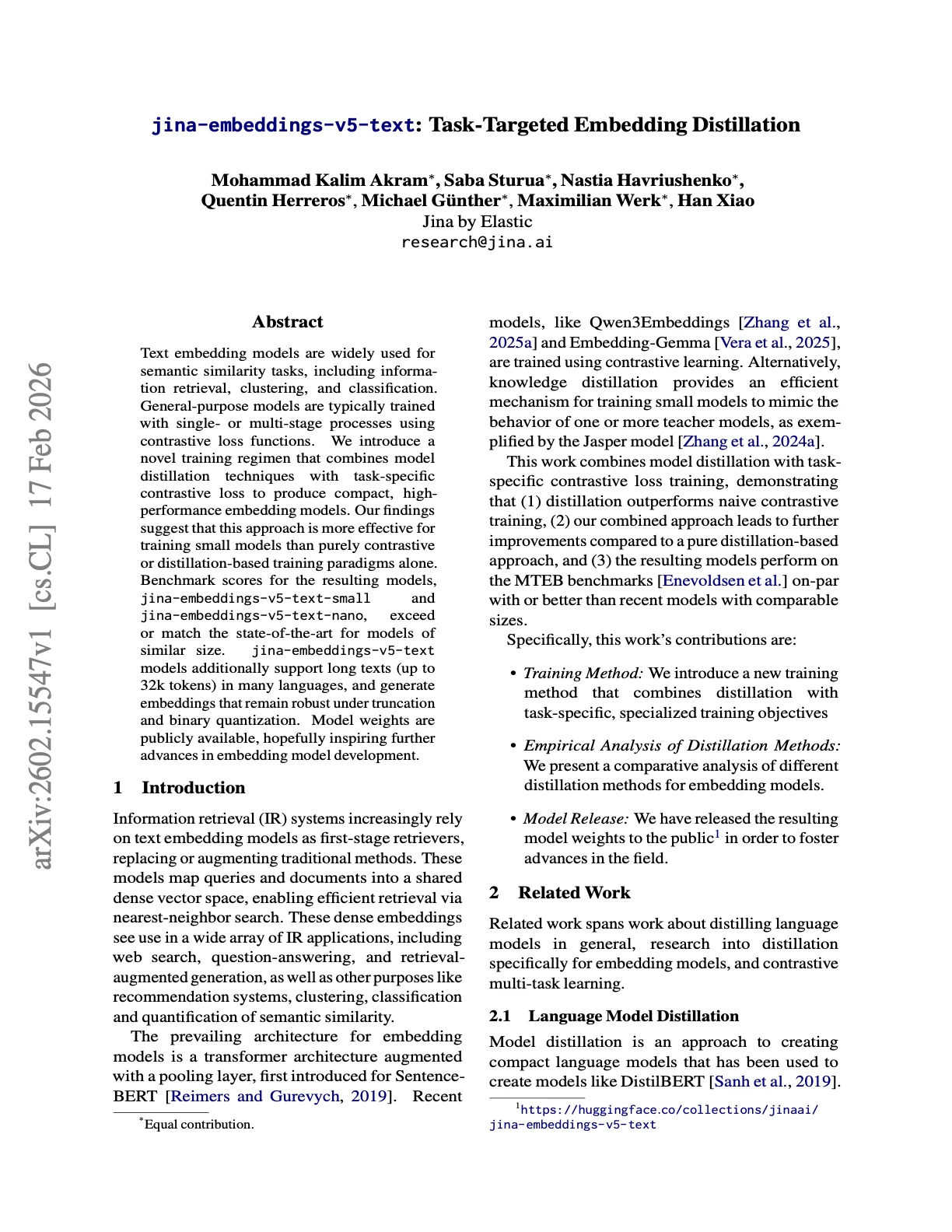
jina-embeddings-v5-text-nano is a 239M parameter multilingual text embedding model built on the EuroBERT-210M backbone, a bidirectional encoder pretrained on 15 major European and global languages. It produces 768-dimensional embeddings via last-token pooling and supports context lengths up to 32K tokens. The model includes four task-specific LoRA adapters (6.7M parameters each) for retrieval, semantic similarity, clustering, and classification. Matryoshka Representation Learning enables embedding truncation to dimensions as low as 32. Trained using embedding distillation from Qwen3-Embedding-4B followed by task-specific adapter training, the model achieves performance competitive with models more than twice its size, making it suitable for latency-sensitive and edge deployments.
Methods
Training follows the same two-stage process as jina-embeddings-v5-text-small but applied to the EuroBERT-210M backbone. First-stage embedding distillation transfers knowledge from Qwen3-Embedding-4B using cosine distance loss with a linear projection layer mapping the student's 768-dimensional embeddings into the teacher's space. Training uses diverse multilingual text pairs from over 300 datasets. In the second stage, four task-specific LoRA adapters (6.7M parameters each) are trained on frozen backbone weights: retrieval (InfoNCE + distillation + GOR), text-matching (CoSENT + distillation), clustering (re-distillation with task-specific teacher instructions), and classification (bidirectional InfoNCE + relational knowledge distillation). The EuroBERT backbone provides strong multilingual coverage across 15 major European and global languages including English, French, German, Spanish, Chinese, Japanese, Arabic, and Hindi.
Performance
On MMTEB (multilingual), jina-embeddings-v5-text-nano achieves 65.5 average (task-level) and 57.7 average (type-level) at just 239M parameters, outperforming all models under 500M parameters including KaLM-mini-v2.5 (60.1, 494M params), voyage-4-nano (58.9, 480M params), and Gemma-300M (61.1, 308M params). It scores 69.2 on classification, 52.7 on clustering, 81.9 on pair classification, 64.6 on reranking, 63.3 on retrieval, and 78.2 on STS. On English MTEB, it achieves 71.0 average, nearly matching the much larger jina-embeddings-v5-text-small (71.7). On retrieval benchmarks, it scores 63.26 on MTEB-M, 64.08 on RTEB, 56.06 on BEIR, and 63.65 on LongEmbed. Embeddings remain robust under binary quantization, with GOR regularization limiting performance degradation to under 2 points on MTEB retrieval.
Best Practice
Select the appropriate LoRA adapter for your task: 'retrieval' for asymmetric query-document search (prepend 'Query:' to queries and 'Document:' to passages), 'text-matching' for symmetric similarity tasks (uses 'Document:' prefix for both inputs), 'clustering' for grouping related documents, and 'classification' for categorization. The nano model is optimized for latency-sensitive and resource-constrained deployments while maintaining competitive accuracy with models more than twice its size. Matryoshka truncation allows reducing embeddings from 768 to as low as 32 dimensions; keep dimensions above 256 for best results. Binary quantization is supported. The EuroBERT backbone provides strong coverage for 15 major languages including English, French, German, Spanish, Chinese, Japanese, Arabic, and Hindi. Use cosine similarity for embedding comparison. Available via Jina AI API, Hugging Face (Sentence Transformers and vLLM), and quantized variants for llama.cpp.
Blogs that mention this model