
 Embeddings
 jina-embeddings-v5-text-small
 GGUF
GGUF MLX
MLX Elastic Inference Service
 Jina API
 AWS SageMaker
 Hugging Face
 Air-gapped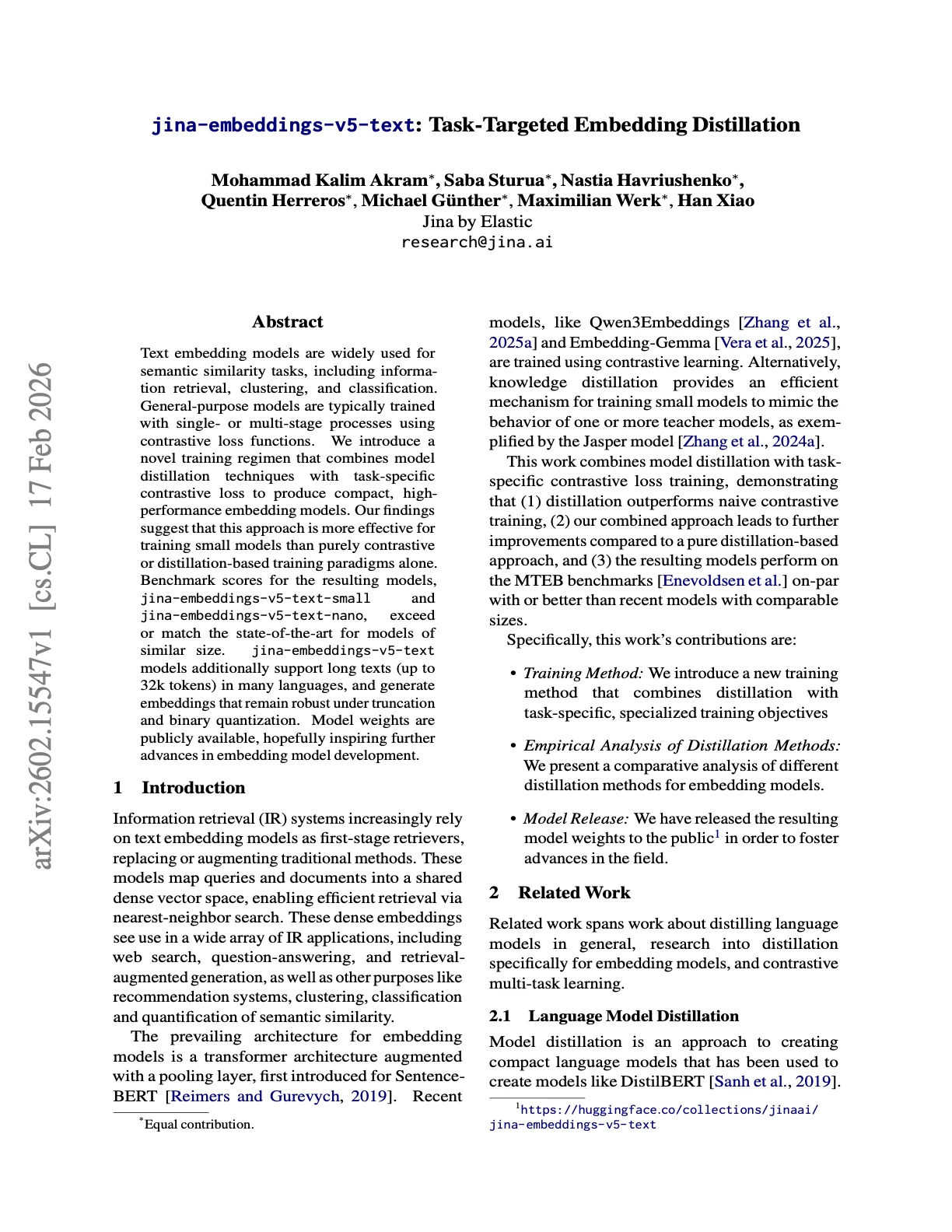
Overview
jina-embeddings-v5-text-small is a 677M-parameter multilingual text embedding model built on the Qwen3-0.6B-Base backbone. It supports 32K token context, produces 1024-dimensional embeddings with Matryoshka truncation down to 32 dimensions, and achieves the highest MTEB average among all models under 1B parameters. It is the default embedding model for Jina's API and the primary recommendation for production RAG pipelines.
Methods
The model is built on Qwen3-0.6B-Base, a multilingual language model pretrained on 119 languages. It employs Last-Token-Pooling to generate embeddings. Training follows a two-stage regimen: (1) embedding distillation from Qwen3-Embedding-4B (a 4B-parameter teacher) transfers high-quality embedding representations to the 677M student; (2) task-specific contrastive loss fine-tunes the model on retrieval, text-matching, clustering, and classification tasks. Geometric Orthogonal Regularization (GOR) ensures embeddings remain robust under binary quantization with minimal performance loss. Matryoshka Representation Learning enables dimension truncation from 1024 to 32 while preserving strong retrieval quality above 256 dimensions. The 32K context window is enabled through rotary position embeddings with tuned base frequencies, and the model was additionally trained on long-context data for robust long-document retrieval.
Performance
On MMTEB (multilingual), the model achieves 67.0 average (task-level) and 58.9 average (type-level), the highest among all models under 1B parameters. Task-level scores: classification 71.3, clustering 53.4, pair classification 82.9, reranking 65.7, retrieval 64.9, STS 78.9. On English MTEB, it achieves 71.7 average, outperforming Qwen3-0.6B with instructions (70.5) and jina-embeddings-v3 (65.7). Retrieval-specific: 64.88 on MTEB-M, 66.84 on RTEB, 56.67 on BEIR, 66.39 on LongEmbed. Notably, the model surpasses its 4B teacher Qwen3-Embedding-4B on pair classification (42.0 vs. 26.8 on MMTEB) while being 6× smaller, demonstrating that distillation combined with task-specific contrastive training can exceed teacher performance on specific tasks.
Best Practice
Select the appropriate LoRA adapter: 'retrieval' for asymmetric query-document search (prepend 'Query:' to queries, 'Document:' to passages), 'text-matching' for symmetric similarity (uses 'Document:' prefix for both inputs), 'clustering' for grouping related documents, 'classification' for categorization and sentiment analysis. Matryoshka truncation to 256–512 dimensions is suitable for storage-constrained indexing; use full 1024 dimensions for re-ranking. Binary quantization is supported with minimal performance loss. The 32K context window handles long documents natively without chunking. Use cosine similarity for embedding comparison. Available via Jina AI API, Hugging Face (Sentence Transformers, vLLM), and quantized variants for llama.cpp. For multimodal workloads, use jina-embeddings-v5-omni-small instead.