
 Reranker
 jina-reranker-v3
 GGUF
GGUF MLX
MLX Elastic Inference Service
 Jina API
 AWS SageMaker
 Microsoft Azure
 Google Cloud
 Hugging Face
 Air-gapped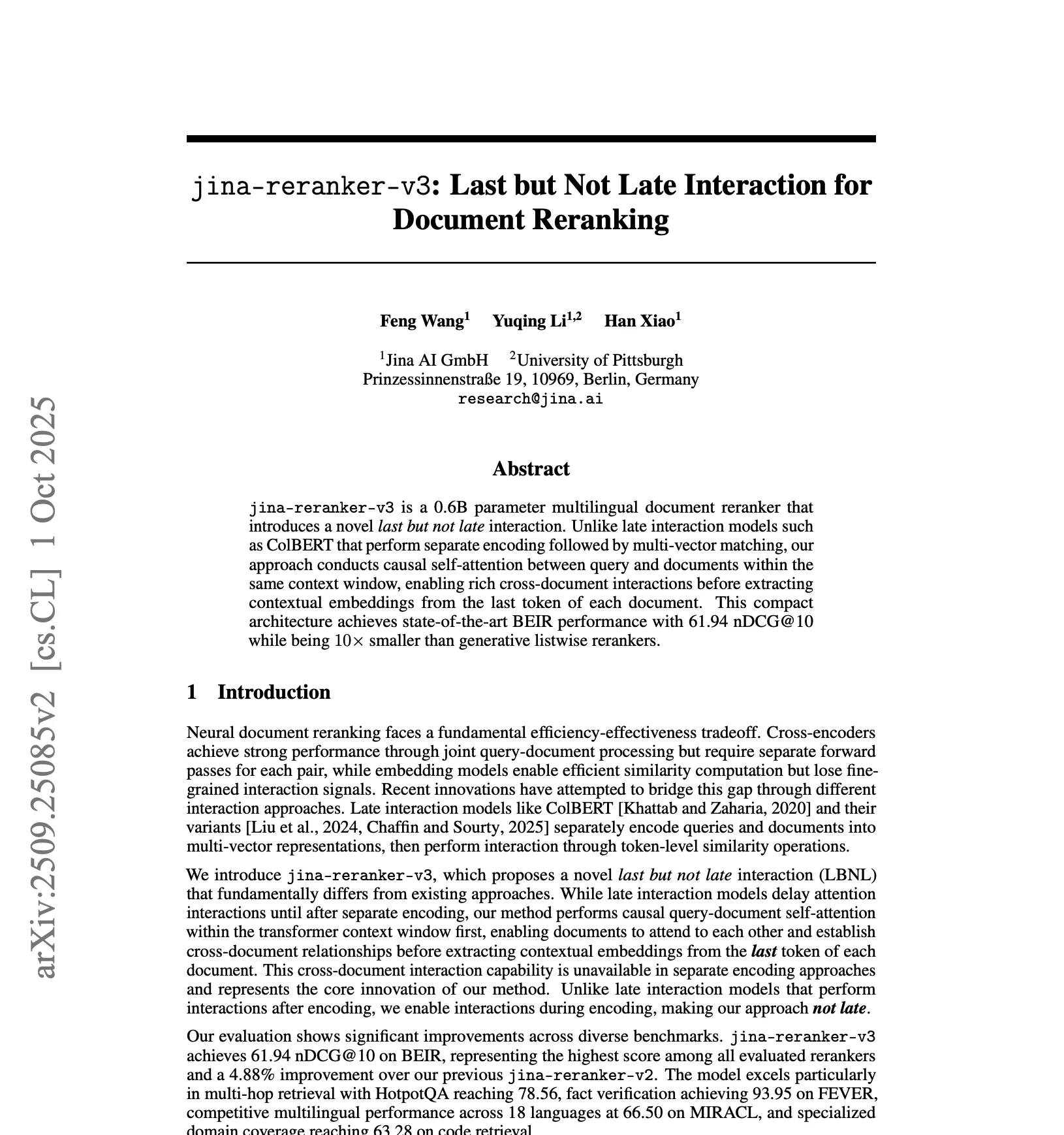
Overview
jina-reranker-v3 is a 597M-parameter multilingual listwise reranker that introduces 'last but not late' (LBNL) interaction — a paradigm shift from pairwise cross-encoder scoring. Instead of evaluating each query-document pair in isolation, it processes an entire list of candidate documents simultaneously within a single 131K-token context window, using causal attention to capture inter-document relationships. It achieves state-of-the-art BEIR performance (61.94 NDCG{'@'}10) with 2.5× fewer parameters than the next-closest competitor.
Methods
The core innovation is the LBNL architecture. In a standard cross-encoder, each query-document pair is scored independently. In a late-interaction model (ColBERT), documents are encoded separately and matched token-by-token. LBNL combines the strengths of both: the query and all candidate documents share a single causal attention context, allowing the model to attend across documents and capture relative relevance signals that pairwise scoring misses. The model processes up to 16 documents per forward pass (one positive, 15 negatives during training), with each document truncated to a fixed length. Embeddings are extracted from the final token of each document via Last-Token-Pooling, leveraging the causal attention mechanism to naturally aggregate information from the preceding context. The 131K token context window is enabled through rotary position embeddings with adjusted base frequencies. Training uses a three-stage progressive curriculum with multi-objective loss combining InfoNCE, dispersive loss (weight 0.45), dual matching loss (weight 0.85), and similarity loss.
Performance
On BEIR, the model achieves 61.94 NDCG{'@'}10, the highest among all evaluated rerankers and a 4.88% improvement over jina-reranker-v2. It excels in multi-hop retrieval (78.56 on HotpotQA) and fact verification (93.95 on FEVER). Multilingual performance reaches 66.50 on MIRACL across 18 languages, with Arabic at 78.69 and Thai at 81.06. Code retrieval achieves 63.28 on CoIR. It outperforms the 1.5B mxbai-rerank-large (61.44) with 2.5× fewer parameters and shows a 5.43% improvement over same-scale bge-reranker-v2-m3. Performance is relatively stable across document orderings: random (62.54), descending (61.94), ascending (61.52) — indicating robust listwise scoring independent of candidate ordering.
Best Practice
Use the structured prompt template with system/user/assistant roles and special tokens for embedding extraction. Process up to 64 documents per forward pass for collections exceeding the 131K context. Optimal with documents ordered randomly or by descending relevance (performance difference is <1%). Leverage the cross-document interaction capability for comparative ranking tasks — the model's listwise design captures relationships between candidates that pairwise scoring misses. For multilingual applications, the model provides strong zero-shot transfer across 18 languages. Implement batch processing for large document sets, maintaining query embeddings consistently across batches. The 256-dimensional output embeddings support efficient similarity computation. Ideal for multi-hop reasoning and fact verification tasks. For production, use jina-reranker-v3.5 for 1.22–1.56× faster inference via hybrid attention.