

 Embeddings
  Apache 2.0 License
 jina-embeddings-v2-base-es
Apache-2.0 Jina API
 AWS SageMaker
'%3e%3cpath%20fill='%23ffffff'%20d='M%20198.351562%2044.007812%20L%20112.046875%20118.847656%20L%2038.398438%20251.039062%20L%20104.804688%20251.039062%20Z%20M%20209.832031%2061.519531%20L%20173%20165.332031%20L%20243.621094%20254.0625%20L%20106.613281%20277.605469%20L%20331.15625%20277.605469%20Z%20M%20209.832031%2061.519531%20'%20fill-opacity='1'%20fill-rule='nonzero'/%3e%3c/g%3e%3c/svg%3e) Microsoft Azure
Microsoft Azure Hugging Face
.%20Filled%20%23ffffff%20like%20the%20other%20csp%20marks%20so%20.svg-img%20inverts%20it%20for%20the%20light%20theme.%20--%3e%3cpath%20fill='%23ffffff'%20d='M13.983%2011.078h2.119a.186.186%200%2000.186-.185V9.006a.186.186%200%2000-.186-.186h-2.119a.185.185%200%2000-.185.185v1.888c0%20.102.083.185.185.185m-2.954-5.43h2.118a.186.186%200%2000.186-.186V3.574a.186.186%200%2000-.186-.185h-2.118a.185.185%200%2000-.185.185v1.888c0%20.102.082.185.185.185m0%202.716h2.118a.187.187%200%2000.186-.186V6.29a.186.186%200%2000-.186-.185h-2.118a.185.185%200%2000-.185.185v1.887c0%20.102.082.185.185.186m-2.93%200h2.12a.186.186%200%2000.184-.186V6.29a.185.185%200%2000-.185-.185H8.1a.185.185%200%2000-.185.185v1.887c0%20.102.083.185.185.186m-2.964%200h2.119a.186.186%200%2000.185-.186V6.29a.185.185%200%2000-.185-.185H5.136a.186.186%200%2000-.186.185v1.887c0%20.102.084.185.186.186m5.893%202.715h2.118a.186.186%200%2000.186-.185V9.006a.186.186%200%2000-.186-.186h-2.118a.185.185%200%2000-.185.185v1.888c0%20.102.082.185.185.185m-2.93%200h2.12a.185.185%200%2000.184-.185V9.006a.185.185%200%2000-.184-.186h-2.12a.185.185%200%2000-.184.185v1.888c0%20.102.083.185.185.185m-2.964%200h2.119a.185.185%200%2000.185-.185V9.006a.185.185%200%2000-.184-.186h-2.12a.186.186%200%2000-.186.186v1.887c0%20.102.084.185.186.185m-2.92%200h2.12a.185.185%200%2000.184-.185V9.006a.185.185%200%2000-.184-.186h-2.12a.185.185%200%2000-.184.185v1.888c0%20.102.082.185.185.185M23.763%209.89c-.065-.051-.672-.51-1.954-.51-.338.001-.676.03-1.01.087-.248-1.7-1.653-2.53-1.716-2.566l-.344-.199-.226.327c-.284.438-.49.922-.612%201.43-.23.97-.09%201.882.403%202.661-.595.332-1.55.413-1.744.42H.751a.751.751%200%2000-.75.748%2011.376%2011.376%200%2000.692%204.062c.545%201.428%201.355%202.48%202.41%203.124%201.18.723%203.1%201.137%205.275%201.137.983.003%201.963-.086%202.93-.266a12.248%2012.248%200%20003.823-1.389c.98-.567%201.86-1.288%202.61-2.136%201.252-1.418%201.998-2.997%202.553-4.4h.221c1.372%200%202.215-.549%202.68-1.009.309-.293.55-.65.707-1.046l.098-.288Z'/%3e%3c/svg%3e) Air-gapped
Air-gapped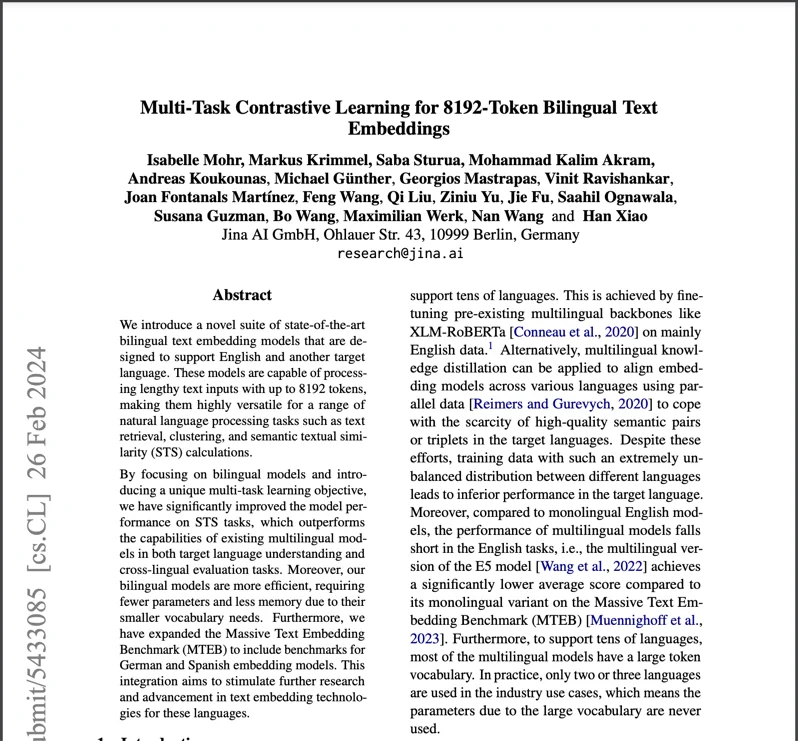
 arXiv
arXiv Overview
jina-embeddings-v2-base-es is a 161M-parameter bilingual text embedding model for Spanish and English, featuring an 8,192-token context window and 768-dimensional output. It was designed for cross-lingual retrieval in Spanish-speaking markets, mapping semantically equivalent Spanish and English content into a shared embedding space. The model addresses a critical gap: most embedding models at the time were English-centric, with Spanish performance significantly degraded.
Methods
The model uses a BERT-based backbone with symmetric bidirectional ALiBi positional encodings, 161M parameters, and a 768-dimensional output space. Training followed a three-stage process: (1) pretraining on Spanish-English parallel corpora, (2) contrastive fine-tuning with hard-negative mining on curated sentence pairs, and (3) cross-lingual alignment to ensure Spanish and English representations of the same concept cluster together. The ALiBi mechanism enables the 8,192-token context without learned positional embeddings, allowing the model to extrapolate beyond its 512-token training length. Mean pooling produces the final embedding vector.
Performance
The model outperformed significantly larger multilingual models (E5, BGE-M3) in Spanish-English retrieval tasks while being only 15–30% of their size. It demonstrated strong performance on MTEB Spanish subtasks, particularly in retrieval and clustering. The 8,192-token context window provided consistent performance on multi-page documents where most competing models required chunking. In 2026, jina-embeddings-v5-text-small supersedes this model, offering 89 languages, 32K context, and task-specific LoRA adapters. The v2-base-es model remains a cost-effective option for dedicated Spanish-English pipelines.
Best Practice
Ideal for Spanish-English bilingual search, content recommendation, and cross-lingual document analysis. For documents exceeding 8,192 tokens, use semantic chunking or the `late_chunking parameter via the Jina API. The model integrates with major vector databases and RAG frameworks. For new projects requiring multilingual coverage beyond Spanish-English, 32K context, or task-specific optimization, prefer jina-embeddings-v5-text-small`. CUDA-capable GPU recommended for production. Input text should be in Spanish or English; mixed-language input is supported but performance is optimized for the two trained languages.


