

 Embeddings
 jina-clip-v2
 Elastic Inference Service
 Jina API
 AWS SageMaker
 Microsoft Azure
 Google Cloud
 Hugging Face
 Air-gapped
Overview
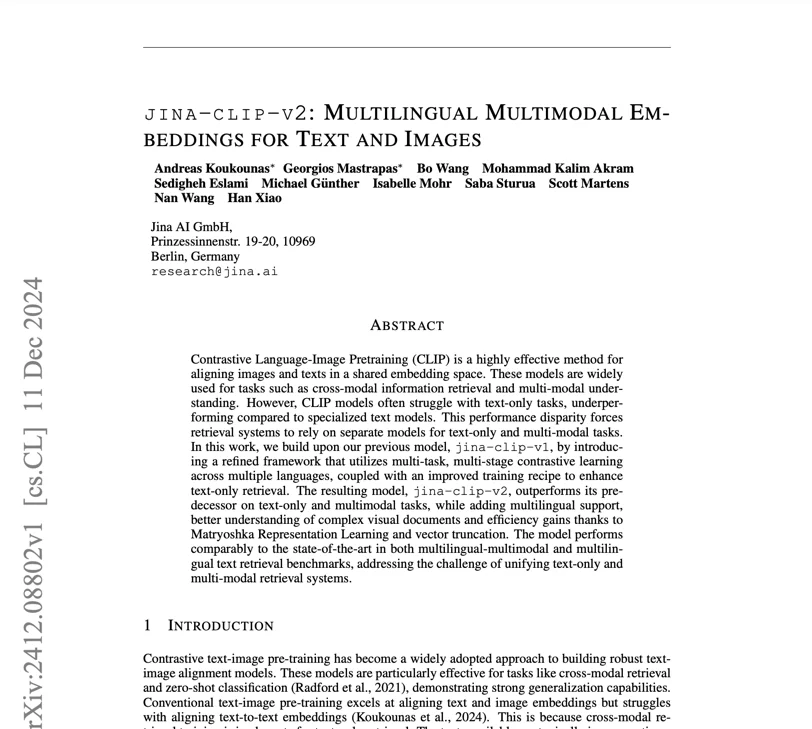
jina-clip-v2 is an 865M-parameter multilingual multimodal embedding model supporting 89 languages and 512×512 image input. It extends jina-clip-v1 with cross-lingual image-text alignment, Matryoshka representation learning for dimension reduction (1024→64), and improved performance on visually rich documents. It achieves state-of-the-art cross-lingual image retrieval while maintaining strong text-only and single-modal performance.
Methods
The model employs a dual-encoder architecture combining a Jina XLM-RoBERTa text encoder (561M parameters, 89 languages, 696,320-token context) with an EVA02-L14 vision encoder (304M parameters, 512×512 pixel input). Training uses a multi-task, multi-stage contrastive learning paradigm: the model is trained on text pairs, text triplets, and image-text pairs simultaneously to support both text-only and cross-modal tasks. The training dataset was expanded to include multilingual texts from 29 non-English languages (including Hindi, Chinese, German, French) and images of visually rich documents. Matryoshka representation learning enables embedding dimension reduction from 1024 to 64 dimensions while preserving over 99% of performance. The model uses Last-Token-Pooling for the final embedding.
Performance
The model achieves 98.0% accuracy on Flickr30k image-to-text retrieval, surpassing both jina-clip-v1 and NLLB-CLIP-SigLIP. In multilingual scenarios, it demonstrates up to 4% improvement over NLLB-CLIP-SigLIP in cross-lingual image retrieval. Embedding compression is remarkably effective: reducing dimensions by 75% (1024→256) still preserves over 99% of performance across text, image, and cross-modal tasks. On Multilingual MTEB, it achieves 69.86% on retrieval and 67.77% on semantic similarity, performing competitively with specialized text embedding models. The 89-language support and visually-rich document handling make it uniquely suited for global e-commerce and content management.
Best Practice
Resize images to 512×512 pixels before processing — larger images are automatically tiled, increasing token usage and processing time. The model excels at matching images with descriptive text across 89 languages, making it ideal for global e-commerce product search, content recommendation, and multilingual visual search. It may struggle with abstract concepts or highly specialized domain content. When using Matryoshka dimension reduction, 64-dimension embeddings maintain strong performance for indexing; use 512+ dimensions for re-ranking critical applications. The model requires CUDA-capable hardware. For text-only workloads, jina-embeddings-v5-text-small offers better accuracy-per-parameter. For code retrieval, use jina-code-embeddings-1.5b. Available via Jina API, AWS, Azure, and GCP marketplaces.