

 Embeddings
  Apache 2.0 License
 jina-embeddings-v2-base-de
Apache-2.0 Jina API
 AWS SageMaker
 Microsoft Azure
 Hugging Face
 Air-gapped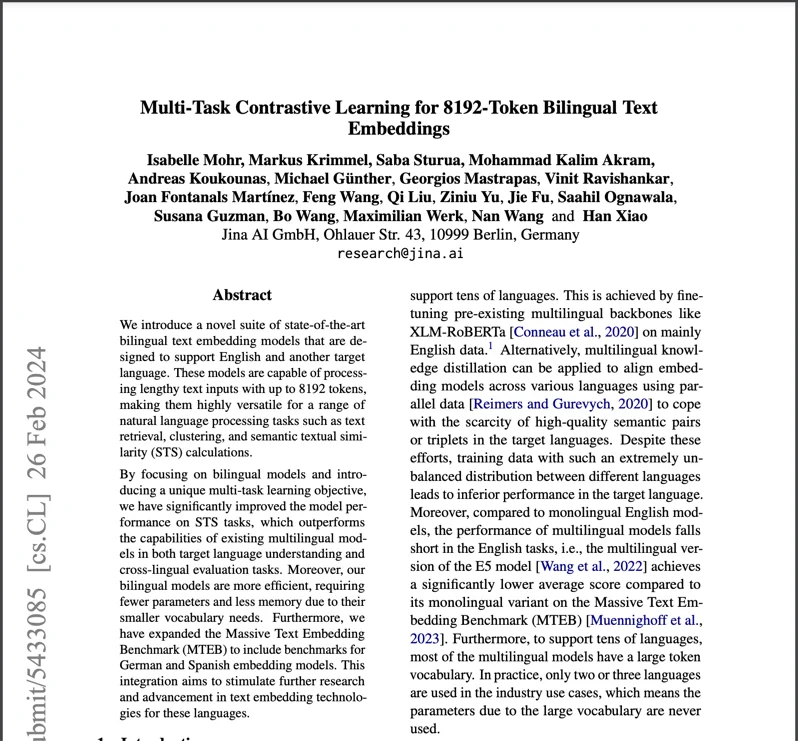
 arXiv
arXiv Overview
jina-embeddings-v2-base-de is a 161M-parameter bilingual text embedding model covering German and English with an 8,192-token context window. It maps semantically equivalent content in both languages into the same 768-dimensional embedding space, enabling cross-lingual retrieval without translation. The model was one of the first open-source bilingual embedding models to combine long-context support with balanced performance across both languages.
Methods
Built on a BERT-based backbone with symmetric bidirectional ALiBi positional encodings, the model processes both German and English through a unified 161M-parameter architecture producing 768-dimensional embeddings. Training included three stages: (1) multilingual pretraining on German-English parallel corpora, (2) contrastive fine-tuning on curated sentence pairs with hard negatives, and (3) cross-lingual alignment training to ensure semantically equivalent texts in German and English map to nearby regions of the embedding space. A key design choice was the bias-minimization objective, which counteracts the tendency of multilingual models to favor English grammatical structures — a documented failure mode in earlier multilingual embeddings. The 8,192-token window via ALiBi enables processing of full documents in either language without truncation.
Performance
The model outperformed Microsoft's E5-base while being less than a third of its size, and matched E5-large performance despite being 7× smaller. On WikiCLIR (English-to-German retrieval), STS17/STS22 (bidirectional semantic similarity), and BUCC (bilingual text alignment), it consistently outperformed models of comparable or larger size. The 322MB footprint enabled deployment on standard hardware. In 2026, jina-embeddings-v5-text-small supersedes this model for most applications, offering 32K context, 89 languages, and task-specific LoRA adapters. The v2-base-de model remains useful for German-English bilingual pipelines where the 8K context is sufficient.
Best Practice
Optimal for German-English bilingual retrieval: product search, support documentation, and content management where queries and documents may be in different languages. For documents exceeding 8,192 tokens, use semantic chunking or the `late_chunking parameter via the Jina API. The model integrates with Qdrant, Weaviate, MongoDB, and Milvus. For new multilingual projects spanning more than two languages, prefer jina-embeddings-v5-text-small` (89 languages, 32K context, LoRA adapters). CUDA-capable GPU recommended for production throughput.


